Dictionary of Spatial Units
Abstract
This document proposes a list of the available nomenclatures integrated (or to be integrated) into the ESPON Database. The following specification may be useful for ESPON Projects when sending their key indicators in the relevant nomenclatures that are supported by the ESPON Database.
1. Regional Nomenclatures
The NUTS is the official division of the EU for regional statistics.
At the beginning of the 1970s, Eurostat set up the NUTS classification as a single, coherent system for dividing up the EU's territory in order to produce regional statistics for the Community. For around thirty years, implementation and updating of the NUTS classification was managed under a series of "gentlemen's agreements" between the Member States and Eurostat.
Work on the Commission Regulation (EC) No 1059/2003, to give NUTS a legal status started in spring 2000. This was adopted in May 2003 and entered into force in July 2003.
The regulation also specifies stability of the classification for at least three years. Stability makes sure that data refers to the same regional unit for a certain period of time. This is crucial for statistics, in particular for time-series.
However, sometimes national interests require changing the regional breakdown of a country. When this happens the county concerned informs the European Commission about the changes. The Commission in turn amends the classification at the end of period of stability according the rules of the NUTS Regulation.
Figure1: NUTS Nomenclatures history (source Eurostat)
A first regular amendment to the annexes, was adopted by Commission Regulation (EC) No 105/2007 and, the NUTS version 2003 was replaced by version 2006 on 1 January 2008. This was preceded by completions of the NUTS classification with the regional breakdowns of the countries that joined the EU in 2004 and 2007 (please see Commission Regulation (EC) No 1888/2005 and Commission Regulation (EC) No 176/2008).
The second regular amendment to the annexes was adopted by Commission Regulation (EU) No 31/2011, entered into force on 7 February 2011 and shall apply, with regard to the transmission of data to the Commission (Eurostat), from 1 January 2012.
The third regular amendment to the annexes was adopted by Commission Regulation (EU) No 1319/2013, entered into force on 31 December 2013 and shall apply, with regard to the transmission of data to the Commission (Eurostat), from 1 January 2015.
The fourth, extraordinary amendment to the annexes was adopted by Commission Regulation (EU) No 868/2014, entered into force on 8 August 2014 and applies, with regard to the transmission of data to the Commission (Eurostat), from 1 January 2015. Please note that any mentioning of 'NUTS 2013' here, in our databases or elsewhere includes the changes of the extraordinary amendment of 2014, thanks to an agreement with the Member State concerned.
The fifth amendment to the annexes (a regular one) was adopted by Commission Regulation (EU) 2016/2066, entered into force on 19 December 2016 and shall apply, regarding the transmission of data to the Commission (Eurostat), from 1 January 2018.
The NUTS Regulation was amended by the Tercet Regulation on 18 January 2018, which introduced a number of territorial typologies into it; see the section "Tercet – Territorial typologies" for more details. The consolidated version of the amended NUTS Regulation is available on EUR-Lex.
ESPON NUTS Version 2003
The following spreadsheet contains the complete description of the extended ESPON NUTS 2003 classification: nomenclature2003.xls.
This section proposes an overview of this nomenclature definition: Table 1 details the source reference structured by country, the maps in Figure 1 show the meshes for levels 1, 2 and 3.
Please find below a list of the main changes compared to the ESPON NUTS 1999 Version. The complete list of changes is available in the sheet entitled changes of the document nomenclature2003.xls.
Creation of Extra-Regio for each country (code=ATZZZ for instance).
Creation of a hierarchical system of code for each country (at NUTS 3 level, "LT" become "LT000").
BE: Code change.
ES: Code change.
DE3/DE4/DE9: Unit merge or split.
IT: Code change, merge and split.
PT: Code change, merge and split.
FI: Code change, merge and split.
PL: Code change, merge and split.
LV: Code change, merge and split.
BG: Code change, merge and split.
. Source reference for the ESPON NUTS Version 2003 structured by country
Country | Study area of reference |
AT - Austria | EU28 |
BE - Belgium | EU28 |
BG - Bulgaria | EU28 |
CH - Switzerland | EU28+4 |
CY - Cyprus | EU28 |
CZ - Czech Republic | EU28 |
DE - Germany | EU28 |
DK - Denmark | EU28 |
EE - Estonia | EU28 |
EL - Greece | EU28 |
ES - Spain | EU28 |
FI - Finland | EU28 |
FR - France | EU28 |
HR - Croatia | EU28 |
HU - Hungary | EU28 |
IE - Ireland | EU28 |
IS - Iceland | EU28+4+CC |
IT - Italy | EU28 |
LI - Liechtenstein | EU28+4 |
LT - Lithuania | EU28 |
LU - Luxembourg | EU28 |
LV - Latvia | EU28 |
ME - Montenegro | EU28+4+CC |
MK - Former Yugoslav Republic of Macedonia | EU28+4+CC |
MT - Malta | EU28 |
NL - Netherlands | EU28 |
NO - Norway | EU28+4 |
PL - Poland | EU28 |
PT - Portugal | EU28 |
RO - Romania | EU28 |
SE - Sweden | EU28 |
Sl - Slovenia | EU28 |
SK - Slovakia | EU28 |
TR - Turkey | EU28+4+CC |
UK - United Kingdom | EU28 |
ESPON NUTS Version 2006
ESPON NUTS Version 2010
ESPON NUTS Version 2013
ESPON NUTS Version 2016
2. Local Nomenclatures
LAU Version 2013
3. Cities
UMZ (Urban Morphological Zones)
FUA
LUZ
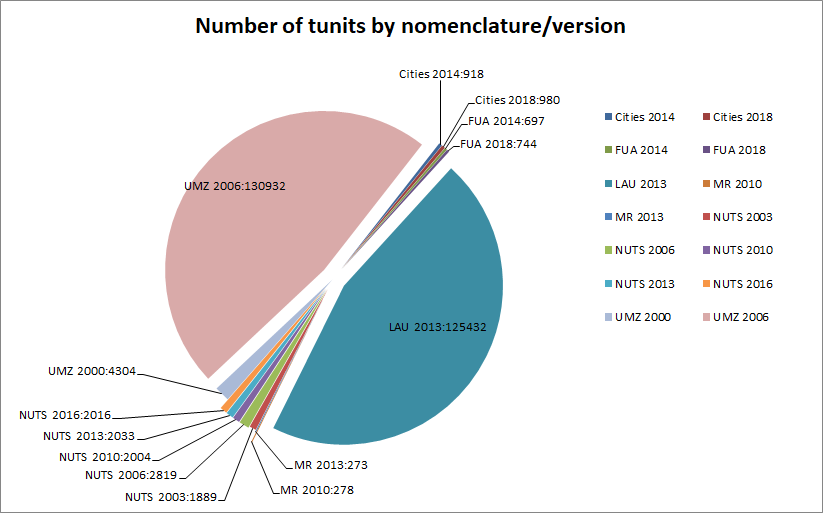
Nomenclature included in ESPON Database 2020 (18 March 2020)